780-1080nm 20W TGG High Power Optical Circulator
Compact, high-power optical circulator built on high-Verdet-constant Terbium Gallium Garnet (TGG) crystals. Provides up to 20W CW power handling, ≥22 dB isolation, and low insertion loss across 780 nm to 1080 nm bands.
Technical Specifications
Parameter
Specification
Unit
Center Wavelength
1064, 1030, 980, 780 or specified
nm
Operating Wavelength Range
±5
nm
Typical Peak Isolation
25
dB
Min. Isolation @ 23°C
22
dB
Typical Insertion Loss @ 23°C
1.3
dB
Max. Insertion Loss @ 23°C
1.5
dB
Min. Extinction Ratio (PM fiber)
20
dB
Max. PDL (SM fiber)
0.15
dB
Min. Return Loss
45
dB
Minimum Crosstalk
45
dB
Max. Average Power (Port 1 + 2)
1, 2, 5, 10, 20 or Specified
W
Max. ns Pulse Peak Power
10 or Specified
kW
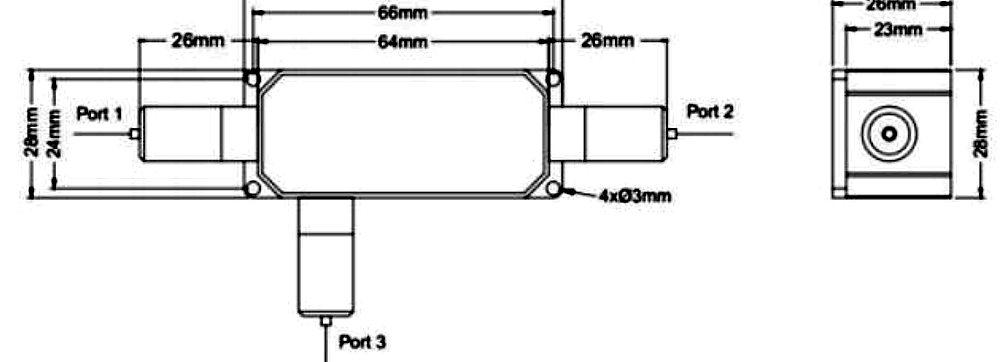
Package Dimensions
64 x 28 x 26 mm
mm
Max. Tensile Load
5
N
Operating Temperature
+10 to +50
°C
Storage Temperature
0 to +60
°C
Technical Datasheet Note
For device with connector, the power handling is 1W only, IL is 0.3 dB higher, RL is 5 dB lower, and ER is 2 dB lower. Default connector key is aligned to slow axis. Custom configurations, fiber types, and packaging are subject to engineering confirmation.
For device with connector, the power handling is 1W only, IL is 0.3 dB higher, RL is 5 dB lower, and ER is 2 dB lower. Default connector key is aligned to slow axis. Custom configurations, fiber types, and packaging are subject to engineering confirmation.
Configuration and ordering notes
High-power circulator review covers routing architecture, wavelength, power conditions and fiber interfaces. Ratings for the selected configuration are listed in the specification table.
Selection Guidance: Compare non-reciprocal routing and optical sensing isolation in our 3-Port Optical Circulator for Fiber Sensing Guide ↗ or 1064nm and 1550nm Optical Circulator Selection.
Key Applications
Fiber laser & amplifier systems; Optical circulator routing in fiber sensors; Coherent Doppler lidar; Laboratory & precision photonic testbeds.
Package Drawing
Need an exact configuration?
A quotation review can begin with the application, quantity and available component information. Wavelength, optical power, fiber and termination details can be clarified with engineering.