TECHNICAL DATASHEET

Mini Size PM DWDM (Dense WDM)

Miniature Polarization-Maintaining Dense Wavelength Division Multiplexer (PM DWDM) on 100 GHz and 200 GHz ITU grids. Provides high channel isolation (>=30 dB adjacent, >=40 dB non-adjacent), low insertion loss (<=1.0 dB pass channel), and exceptional thermal stability in a micro dia. 3.2 x 30 mm package.

Technical Specifications

Parameter
Specification
Unit
Channel Spacing
100 / 200
GHz
Center Wavelength
ITU Grid (C-Band / L-Band)
nm
Center Wavelength Accuracy
±0.05 (100 GHz) / ±0.1 (200 GHz)
nm
Channel Passband (@ -0.5 dB)
0.22 (100 GHz) / 0.5 (200 GHz)
nm
Max. Insertion Loss (Pass)
1.0 (100 GHz) / 0.9 (200 GHz)
dB
Max. Insertion Loss (Reflection)
0.4
dB
Min. Isolation (Adjacent)
30
dB
Min. Isolation (Non-Adjacent)
40
dB
Min. Isolation (Reflection Channel)
12
dB
Max. Channel Flatness
0.3
dB
Min. Extinction Ratio @ 23°C
20
dB
Wavelength Thermal Stability
0.003
nm/°C
Insertion Loss Thermal Stability
0.005
dB/°C
Min. Return Loss
50
dB
Max. Optical Power (CW)
500
mW
Fiber Type
PM Panda Fiber
-
Operating Temperature
-5 to +70
°C
Storage Temperature
-40 to +85
°C
Package Dimensions
dia. 3.2 x 30 mm
mm
Technical Datasheet Note
With connectors, IL increases by 0.3 dB, RL decreases by 5 dB and ER decreases by 2 dB. Specify exact ITU grid channel (e.g. C21, C34) and fiber pigtail length upon RFQ.
Configuration and ordering notes

Channel spacing and passband requirements define the DWDM configuration. Listed insertion-loss values apply to the corresponding model.

Selection Guidance: Review footprint reduction, splice elimination and optical loss budget in our Mini & Hybrid Devices for CPO & Transceivers Guide ↗ or Mini vs Standard Isolator Guide ↗.

Key Applications

Compact DWDM optical transceivers; Optical add/drop multiplexing (OADM); Dense sensor interrogation arrays; High-capacity optical communication networks.

Package Drawing
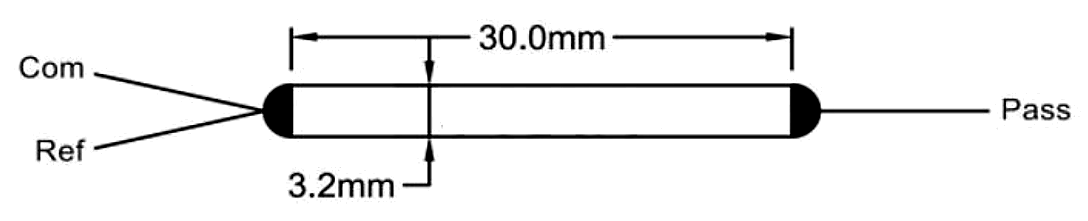
054 Mini Size PM DWDM (Dense WDM), Channel Spacing: 100 / 200 – KernsOptic
Package reference for Mini Size PM DWDM (Dense WDM). Confirm the final configuration during engineering review.

Need an exact configuration?

A quotation review can begin with the application, quantity and available component information. Wavelength, optical power, fiber and termination details can be clarified with engineering.