(2+1)x1 PM Pump and Signal Combiner
Polarization-maintaining (2+1)×1 and (1+1)×1 pump and signal combiner for high-power fiber lasers and optical amplifiers. Couples two multimode pump beams (800–1000nm) and one PM seed signal (1030–1080nm or 1450–1600nm) into a double-clad output PM fiber with >90%–95% pump efficiency, signal insertion loss ≤0.5 dB, and PER ≥18 dB.
Technical Specifications
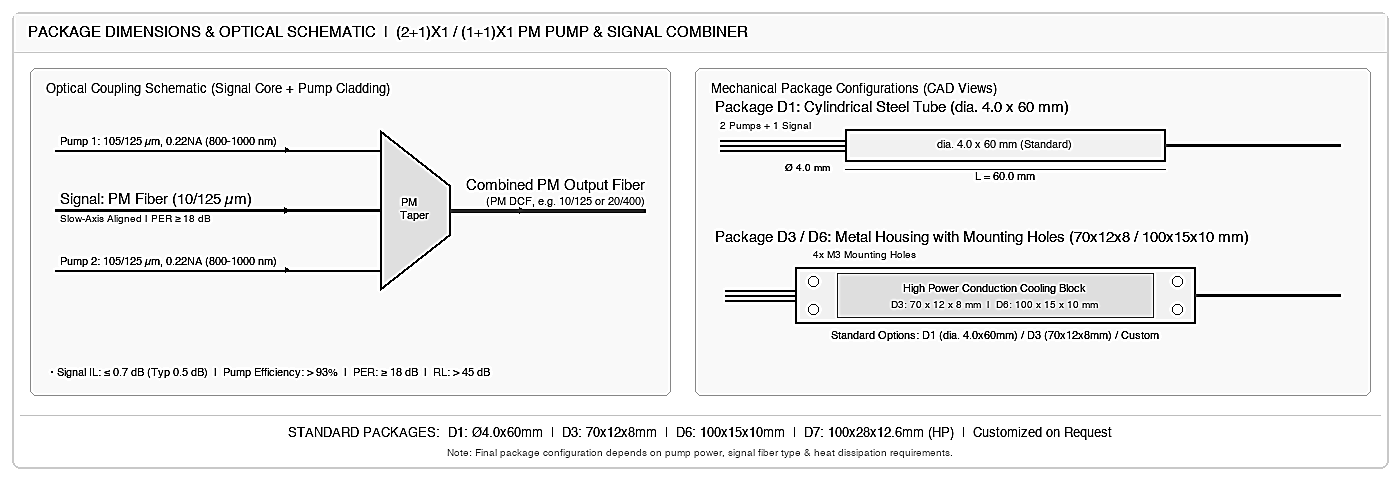
Signal port uses PM panda fiber aligned to slow axis. Double-clad output fiber preserves both signal beam quality and pump brightness with minimal heat dissipation.
Configuration and ordering notes
Configuration parameters include signal wavelength (1030-1080nm for Yb lasers or 1550nm for Er-Yb lasers), pump diode count (1 or 2 ports), and double-clad output fiber geometry.
Key Applications
High-power MOPA fiber laser amplifiers, polarization-maintaining fiber amplifiers, coherent beam combining systems, and LIDAR laser transmitters.
Package Drawing
Need an exact configuration?
A quotation review can begin with the application, quantity and available component information. Wavelength, optical power, fiber and termination details can be clarified with engineering.