TECHNICAL DATASHEET

1x2 / 2x2 Mini Single Mode Fiber Coupler (FSMC / FWBC / DWFC)

Miniature Single-Mode Fused Fiber Coupler in an ultra-compact package (dia. 2.4 x 25 mm or dia. 3.0 x 40 mm). Available in single window (FSMC), wideband (FWBC), and dual window (DWFC) versions across 1310nm and 1550nm bands with low excess loss (<=0.1 dB) and high directivity (>55 dB).

Technical Specifications

Parameter
Specification
Unit
Port Configuration
1x2 / 2x2
-
Operating Wavelength
1310, 1550, or 1310/1550 Dual Window
nm
Operating Bandwidth
±15 (Single Window), ±40 (Wideband)
nm
Coupling Ratio Options
01/99, 05/95, 10/90, 20/80, 50/50
%
Max. Excess Loss (A Grade)
0.10 (50/50), 0.15 (Tap ratios)
dB
Min. Directivity
55
dB
Min. Return Loss
55
dB
Max. Polarization Dependent Loss (PDL)
0.08 (50/50), 0.10 (Tap)
dB
Max. Optical Power (CW)
500
mW
Fiber Type
Corning SMF-28e+ or equivalent
-
Operating Temperature
-40 to +85
°C
Package Dimensions
dia. 2.4 x 22 mm / dia. 2.4 x 25 mm / dia. 2.4 x 30 mm / dia. 3.0 x 35 mm
mm
Technical Datasheet Note
A Grade and P Grade available. Ultra-mini package (dia. 2.4 x 25 mm) available with 250um bare fiber leads. Connectors add 0.3 dB insertion loss.
Configuration and ordering notes

Configuration parameters include port configuration (1x2 or 2x2), coupling ratio (e.g. 50/50 splitter, 1/99 tap), and package size (dia. 2.4 x 25mm for ultra-compact boards).

Selection Guidance: Review footprint reduction, splice elimination and optical loss budget in our Mini & Hybrid Devices for CPO & Transceivers Guide ↗ or Mini vs Standard Isolator Guide ↗.

Key Applications

Compact optical transceivers and SFP/QSFP modules; Passive optical networks (PON); Fiber optic sensing instruments; Laboratory photonics.

Package Drawing
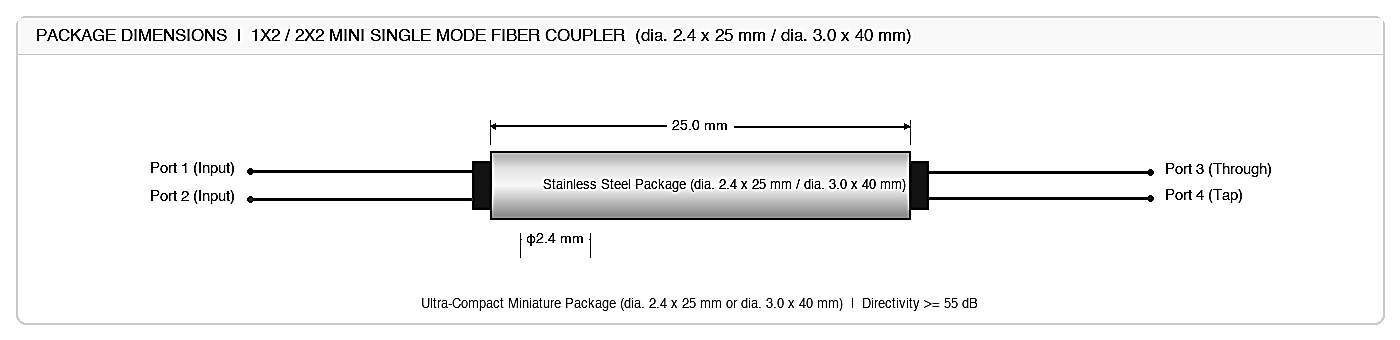
088 1x2 / 2x2 Mini Single Mode Fiber Coupler (FSMC / FWBC / DWFC), Port Configuration: 1x2 / 2x2 – KernsOptic
Package reference for 1x2 / 2x2 Mini Single Mode Fiber Coupler (FSMC / FWBC / DWFC). Confirm the final configuration during engineering review.

Need an exact configuration?

A quotation review can begin with the application, quantity and available component information. Wavelength, optical power, fiber and termination details can be clarified with engineering.