780-2050nm PM Polarization Beam Splitter / Combiner
PM polarization beam splitter/combiner for the listed 780–2050 nm wavelength groups. Insertion loss varies by wavelength and grade; compare the corresponding rows in the downloadable datasheet before requesting a configuration.
Technical Specifications
Parameter
Specification
Unit
Center Wavelength
780, 850, 980, 1030, 1064, 1310, 1480, 1550, 2000, 2050
nm
Operating Wavelength Range
±20 (1310-2050), ±10 (780-1064)
nm
Typ. Insertion Loss
0.4 (Grade P), 0.6 (Grade A)
dB
Max. Insertion Loss
0.6 (Grade P), 0.8 (Grade A)
dB
Min. Extinction Ratio (Port 3)
≥ 20 (Grade P), ≥ 18 (Grade A)
dB
Min. Return Loss
≥ 50
dB
Min. Directivity
≥ 50
dB
Max. Optical Power (CW)
500
mW
Fiber Type (Port 1 & 2)
PM Panda Fiber
-
Fiber Type (Port 3)
PM Panda or SMF-28e
-
Package Dimensions
dia. 5.5 x 35 mm
-
Operating Temperature
-5 to +70
°C
Technical Datasheet Note
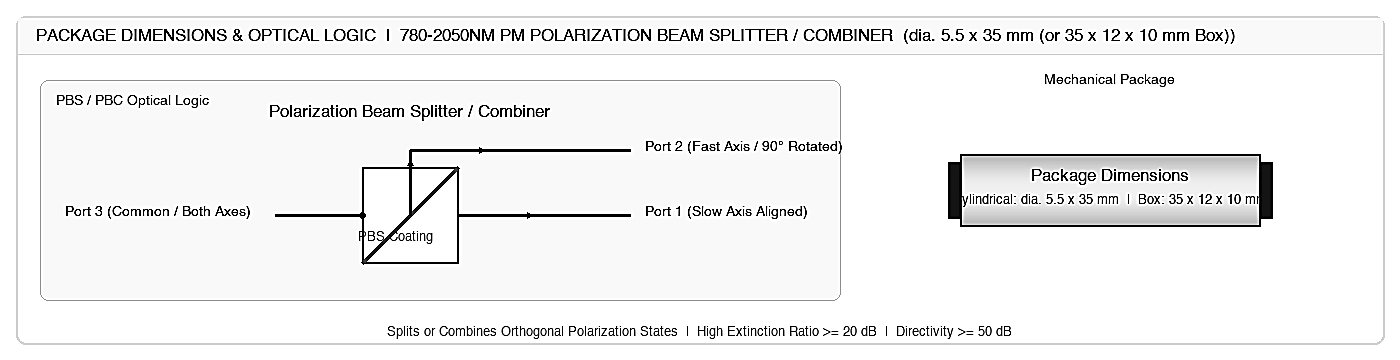
Functioning as PBC, combines two orthogonal polarization signals into one output fiber. Functioning as PBS, separates orthogonal states into Port 1 and Port 2.
Functioning as PBC, combines two orthogonal polarization signals into one output fiber. Functioning as PBS, separates orthogonal states into Port 1 and Port 2.
Configuration and ordering notes
Configuration parameters include operating wavelength, Grade (P or A), Port 3 fiber type (SMF vs PM), pigtail loose tube (bare fiber vs 900µm), and connector options.
Selection Guidance: Review extinction ratio formulas, axis alignment, and splicing tolerances in our PM Fiber Components & Extinction Ratio Guide ↗ or Fiber Polarizer Selection Guide ↗.
Key Applications
EDFA and Raman amplifier pump multiplexing, coherent optical receiver balance mixing, polarization mode dispersion (PMD) compensation, and fiber sensors.
Package Drawing
Need an exact configuration?
A quotation review can begin with the application, quantity and available component information. Wavelength, optical power, fiber and termination details can be clarified with engineering.