Mini Size PM Optical Isolator
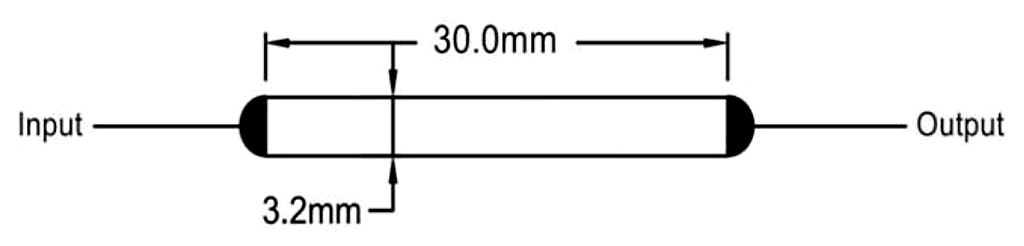
Miniature PM optical isolator for compact modules and fiber sensing. Package options are dia. 3.0 x 30 mm or dia. 3.2 x 30 mm. Insertion loss and isolation depend on wavelength and stage; compare the matching specification-table entries.
Technical Specifications
Single / Dual values are shown in the same order. With connectors, IL increases by 0.3 dB, RL decreases by 5 dB and ER decreases by 2 dB. Custom configurations, connector types, and fiber lengths are subject to engineering confirmation.
Configuration and ordering notes
Single-stage and dual-stage versions have different isolation and loss characteristics. Wavelength, PM fiber and pigtail configuration are reviewed with the listed specifications.
Package Drawing
Frequently Asked Questions
Which wavelengths are listed for this miniaturized PM optical isolator?
The specification table lists center wavelengths of 1310, 1550, 1064 and 1030 nm. Insertion loss and isolation depend on wavelength and stage; use the matching table entry rather than a single value for every option.
Is 0.55 dB insertion loss a typical or maximum value?
For the single-stage 1310/1550 nm options at 23 degrees C, the table specifies 0.4 dB typical and 0.55 dB maximum insertion loss. Dual-stage 1310/1550 nm options are 0.55 dB typical and 0.75 dB maximum. These values do not apply to all wavelengths; see the table and its connector adjustment note.
What optical power range is specified?
The table specifies a maximum continuous-wave optical power of 300 mW; a minimum operating power is not specified. Confirm the operating conditions for your configuration with engineering.
What should I check for a miniature fiber sensor assembly?
Fiber sensing is listed under Key Applications. The specification table lists PM Panda fiber and package dimensions of dia. 3.0 x 30 mm or dia. 3.2 x 30 mm. For a fiber sensor assembly, review the miniature package, stage and wavelength against the optical loss budget.
Need an exact configuration?
A quotation review can begin with the application, quantity and available component information. Wavelength, optical power, fiber and termination details can be clarified with engineering.