Short Wavelength Fused Fiber Coupler (633nm, 780nm, 850nm, 980nm, 1064nm)
Short-Wavelength Fused Single-Mode Fiber Coupler operating at visible and near-infrared wavelengths (633nm, 780nm, 850nm, 980nm, 1064nm). Built with specialized single-mode fibers (HI780, HI1060, SM600) for biophotonics, Raman spectroscopy, and laser diode seed splitting.
Technical Specifications
Parameter
Specification
Unit
Center Wavelength
633, 780, 850, 980, 1064
nm
Operating Bandwidth
±15 (633/780/850), ±20 (980/1064)
nm
Port Configuration
1x2 / 2x2
-
Coupling Ratio Options
01/99, 05/95, 10/90, 20/80, 50/50
%
Max. Excess Loss (A Grade)
0.20 (1064/980), 0.30 (850/780), 0.40 (633)
dB
Max. Polarization Dependent Loss
0.10 (1064/980), 0.15 (850-633)
dB
Min. Directivity
55
dB
Min. Return Loss
50
dB
Max. Optical Power (CW)
500
mW
Fiber Type
HI1060 (980/1064), HI780 (780/850), SM600 (633)
-
Operating Temperature
-40 to +75
°C
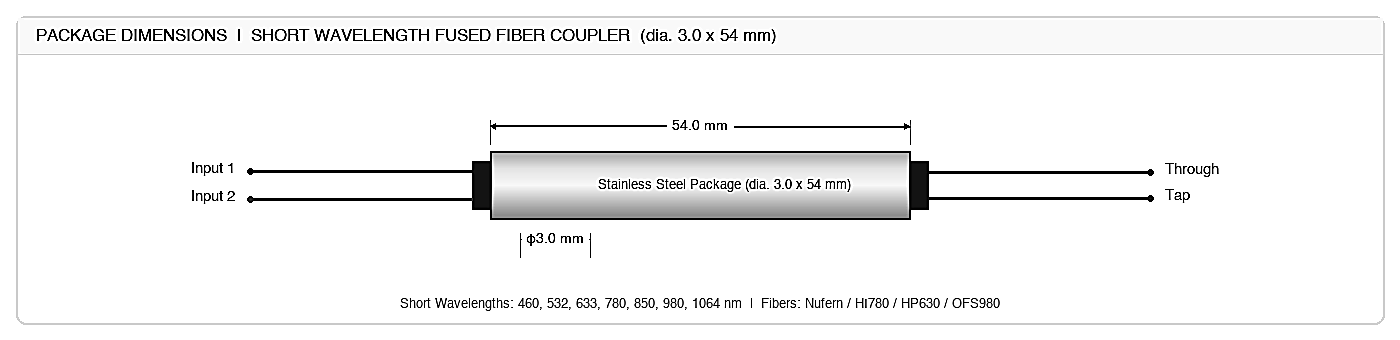
Package Dimensions
dia. 3.0 x 54 mm / 90 x 20 x 9.5 mm
mm
Technical Datasheet Note
Short-wavelength operation requires single-mode fiber matched to cut-off wavelength. Connectors add 0.3 dB insertion loss.
Short-wavelength operation requires single-mode fiber matched to cut-off wavelength. Connectors add 0.3 dB insertion loss.
Configuration and ordering notes
Configuration parameters include operating wavelength (e.g. 633nm for He-Ne laser, 780/850nm for sensing, 1064nm for Nd:YAG/Yb lasers) and splitting ratio.
Selection Guidance: Review extinction ratio formulas, axis alignment, and splicing tolerances in our PM Fiber Components & Extinction Ratio Guide ↗ or Fiber Polarizer Selection Guide ↗.
Key Applications
Biomedical flow cytometry; Confocal microscopy; Raman spectroscopy; Optical coherence tomography (OCT); Laser diode seed tapping.
Package Drawing
Need an exact configuration?
A quotation review can begin with the application, quantity and available component information. Wavelength, optical power, fiber and termination details can be clarified with engineering.