0.3-50W High Power PM In-Line Optical Isolator
High-power polarization-maintaining in-line isolator for 1030 nm and 1064 nm fiber laser systems, handling average optical powers from 0.3 W up to 50 W and peak powers up to 10 kW. Built with advanced thermal dissipation packaging and high-extinction TGG crystal optics for robust backward ASE and back-reflection isolation.
Technical Specifications
For connectorized devices, IL increases by 0.3 dB, ER decreases by 2 dB, RL decreases by 5 dB and maximum guaranteed handling power is 1 W. High-power operation (>5 W) requires bare fiber or high-power collimated beam termination with adequate heat sinking.
Configuration and ordering notes
Configuration parameters include operating power level (0.3W, 10W, 20W, 30W, or 50W) and center wavelength (1030 nm for Yb-doped femtosecond lasers or 1064 nm for CW/MOPA fiber lasers). Engineering review covers fiber type (e.g. PM980, PM 10/125, or custom LMA fiber) to match the laser optical path.
Key Applications
High-power MOPA fiber laser systems; Industrial ultrafast fiber lasers; Pulsed fiber amplifiers; Laser marking and precision micromachining.
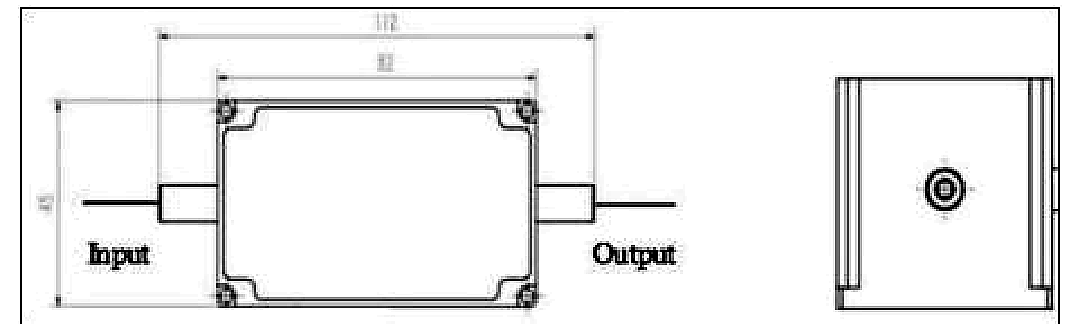
Package Drawing
Need an exact configuration?
A quotation review can begin with the application, quantity and available component information. Wavelength, optical power, fiber and termination details can be clarified with engineering.