TECHNICAL DATASHEET

980-1080nm TGG Optical Isolator + Optical Filter 2-in-1 Hybrid

Integrated 2-in-1 optical hybrid combining a high-isolation TGG optical isolator and a narrow bandpass optical filter. Eliminates amplified spontaneous emission (ASE) noise while blocking backward laser reflection in fiber laser and amplifier optical trains handling up to 20W CW optical power.

Technical Specifications

Parameter
Specification
Unit
Center Wavelength
1064, 1030, 980
nm
Operating Wavelength Range
±5
nm
Passband Width (@ -0.5 dB)
2.0, 5.0, 8.0, 15.0 or specified
nm
Stopband Width (@ -25 dB)
<= 6.0 (for 2nm bandpass)
nm
Min. Isolation @ 23°C
28 (Single Stage) / 45 (Dual Stage)
dB
Max. Insertion Loss @ 23°C
1.5 (2nm passband), 1.2 (5nm passband)
dB
Min. Extinction Ratio @ 23°C
20 (PM type, Both axes) / 22 (Fast axis blocked)
dB
Min. Return Loss
50
dB
Max. Optical Power (CW)
10 / 20
W
Fiber Type
PM980, HI1060, LMA-GDF-10/125 Panda Fiber
-
Operating Temperature
+10 to +50
°C
Storage Temperature
-20 to +60
°C
Package Dimensions
58 x 28 x 26 mm
mm
Technical Datasheet Note
2-in-1 integration eliminates one splice point (saving ~0.3 dB IL) and saves 50% enclosure footprint. 20W models require mounting to heat dissipation base.
Configuration and ordering notes

Configuration parameters include passband bandwidth (2nm for ASE suppression, 5nm or 10nm for wider bandwidth pulses) and required isolation stage (Single or Dual Stage).

Selection Guidance: Review footprint reduction, splice elimination and optical loss budget in our Mini & Hybrid Devices for CPO & Transceivers Guide ↗ or Mini vs Standard Isolator Guide ↗.

Key Applications

Pulsed fiber laser seed source noise filtering; High-power fiber amplifier pre-amplification; Ultrafast laser ASE cleaning; Raman scattering filtering.

Package Drawing
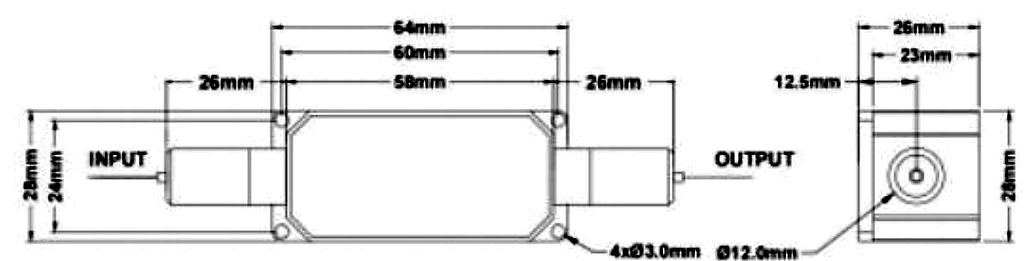
083 980-1080nm TGG Optical Isolator + Optical Filter 2-in-1 Hybrid, Center Wavelength: 1064, 1030, 980 – KernsOptic
Package reference for 980-1080nm TGG Optical Isolator + Optical Filter 2-in-1 Hybrid. Confirm the final configuration during engineering review.

Need an exact configuration?

A quotation review can begin with the application, quantity and available component information. Wavelength, optical power, fiber and termination details can be clarified with engineering.